Biogas continues to be mentioned as a cost effective, clean, green energy that is a most preferred alternative to turn to as a result of the increase in price of fuel leading to exaggerated cost of cooking gas and Liquified Petroleum Gas. (LPG). It is however limited since not everyone can benefit from it as the gas majorly depends on regular distribution of waste products from domestic animals like cow dung, pig droppings. This makes zero-grazing, dairy and pig farmers to fully and easily benefit from the option as they get the raw materials free of charge. The readily available clean, green energy is only costly at the initial stages of installation of bio-digester receptacles up to the houses which is a one-time procedure and cannot be compared to the cost of petroleum gas or cooking gas. The bio-digester is the receptacle that stores the methane gas produced from animals’ wastes. Biogas is eco-friendly, reduces soil and water pollution, it involves the use of few technological advances, hence not complicated to use. Improper installation of the bio-digester receptacle can however lead to blowing up with severe damages which can be prevented and cannot be compared to its cost effectiveness. Since farming is wide spread across the world, methane use from farming activities is highly encouraged to help solve the problem of green waste in markets. The effluent from bio- digesters can still be used as manure hence nothing goes to waste, the soil also benefits and gains fertility. There are companies in Kenya that deal with installation of bio-digester receptacles hence this is not a new concept in Kenya. Citizens and institutions are however urged to use biogas for clean energy and even if they do not have free access to the animals’ wastes, they can get them from nearby slaughter houses at a fee. Citizens and farmers who have been using biogas for cooking and lighting have greatly benefited and do not have any regrets of using it. They have no dream of turning back to other sources of energy. The merits outweigh the demerits and since nobody wants to spend more money on cooking and petroleum gas, with the tough times brought to the economy by Covid-19, biogas is the immediate remedy, and one can get the raw materials free of charge. Kenya is making efforts to use clean energy like wind power and geothermal, farmers should therefore feel challenged to use little or no cost at all for energy and especially during these tough economic times of price increment in fuel products.
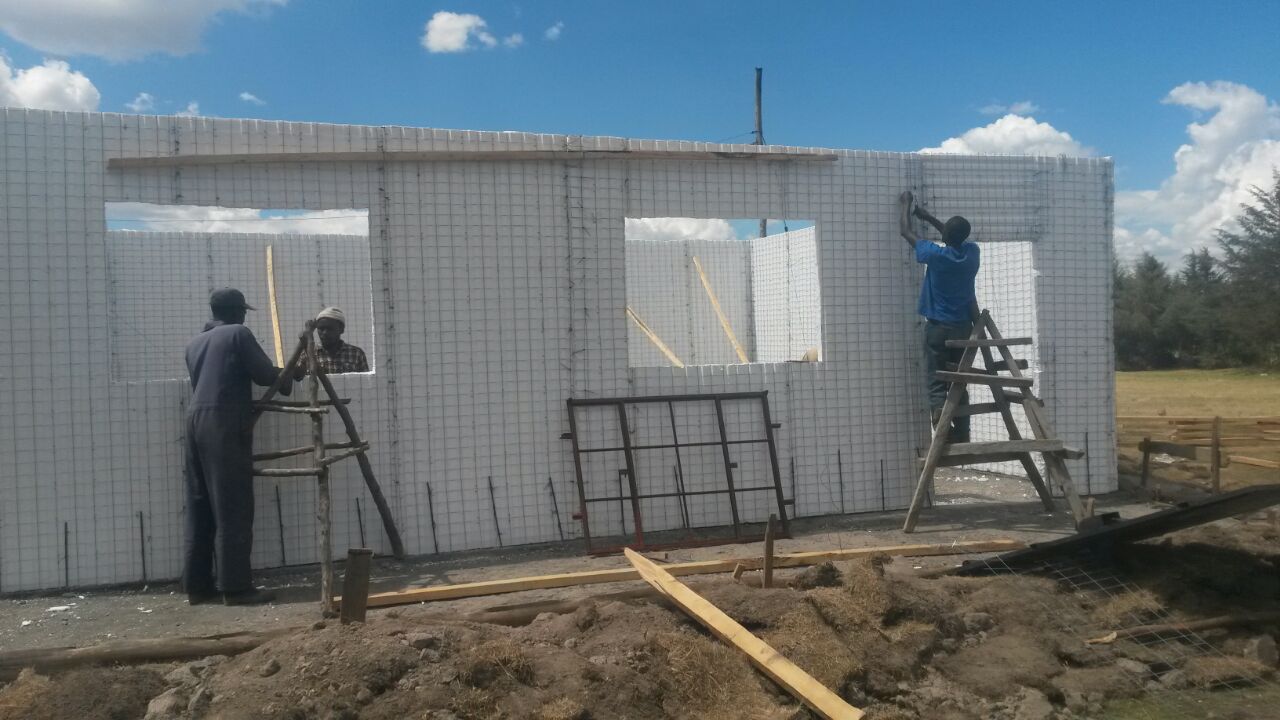
In Kenya, real estate developers are increasingly turning to innovative construction methods to address the mounting costs of building projects while upholding structural quality. Among these pioneering techniques is the utilization of Expanded Polystyrene (EPS) construction, a process that involves the assembly of houses by incorporating EPS panels sandwiched between steel wire mesh and enveloped with concrete on both sides. EPS panels, composed of solid beads of polystyrene, are produced in a factory and then transported to the construction site for assembly, significantly curbing material wastage and thereby reducing costs. A typical 100-square-meter, two-bedroom house requires approximately 70 panels, each weighing 15 kilograms, which means an entire house can be transported in a single lorry load. Construction Efficiency According to Kenrick Miako, a director at Mikooh Exquisite Ltd., a company that has successfully utilized EPS panels in the construction of flats in Rongai, this innovative technology has allowed them to slash their construction expenses by 25% while halving the construction timeline. Miako emphasizes, “This technology not only reduces labor costs and construction time but also demands less reinforcement due to its lightweight nature. Additionally, it offers savings in the foundation phase.” These lightweight panels are employed in erecting walls, stairways, floors, and perimeter walls. Bricks are only used in the foundation, with EPS panels taking over from there up to the slab, resulting in superior structures and enabling high-quality finishes. Multi-Story Structures Remarkably, despite their lightness, modular houses built with EPS technology are robust enough to withstand natural disasters more effectively than those constructed with traditional materials. EPS technology can be extended to the construction of buildings up to 20 stories high. Mike Juma, an engineering technologist at the National Housing Corporation (NHC), explains, “Buildings collapse primarily due to their own weight. EPS is exceptionally lightweight and possesses a superior strength-to-weight ratio compared to conventional building blocks.” With a 35mm concreting of EPS panels and 15mm plaster finishes on both sides of the wall, the result is a thickness equivalent to a standard 9×9 building block. Juma further states that a four-story building without columns or a double wall panel project ranging from 11 to 20 stories without columns can be accomplished. “For buildings with frame structures,” he adds, “the height can be virtually limitless as EPS panels can be used as filler materials.” In 2011, NHC established an EPS panel manufacturing facility in Mavoko, Machakos County, and has since employed EPS technology in the construction of residential flats nationwide. They have also collaborated with private investors across the country who have adopted this cost-effective technology. Construction Costs Regarding the cost of EPS building technology in Kenya, Juma notes that panels are produced in various modules and variations of wall and slab panels, each with differing price points. For instance, a builder can construct a wall using EPS panels for approximately KES 1,800 per square meter and a slab for about KES 2,350 per square meter. This translates to approximately KES 600,000 for a studio flat and around KES 1.5 million for a standard two-bedroom house. While the adoption of EPS panels as a construction method is relatively new in Kenya, it has been widely utilized in developed countries for years due to its durability, lightweight nature, ease of installation, and cost-saving advantages. Other benefits include thermal insulation, maintaining comfortable temperatures, high resistance to fire and other hazards, and structures that are soundproof and impervious to termites, rodents, and other pests due to the material’s lack of nutritional value. Drawbacks Nevertheless, one notable drawback of EPS technology is that polystyrene is an oil-based product that isn’t easily recyclable on an industrial scale. Consequently, EPS foam waste often finds its way into the environment, where it remains non-degradable, breaking down into harmful particles over time, posing risks to both humans and animals.